
A Lonely Massive Star Reveals Secrets of Stellar Chemistry
Contributor: Dr. Mélisse Bonfand
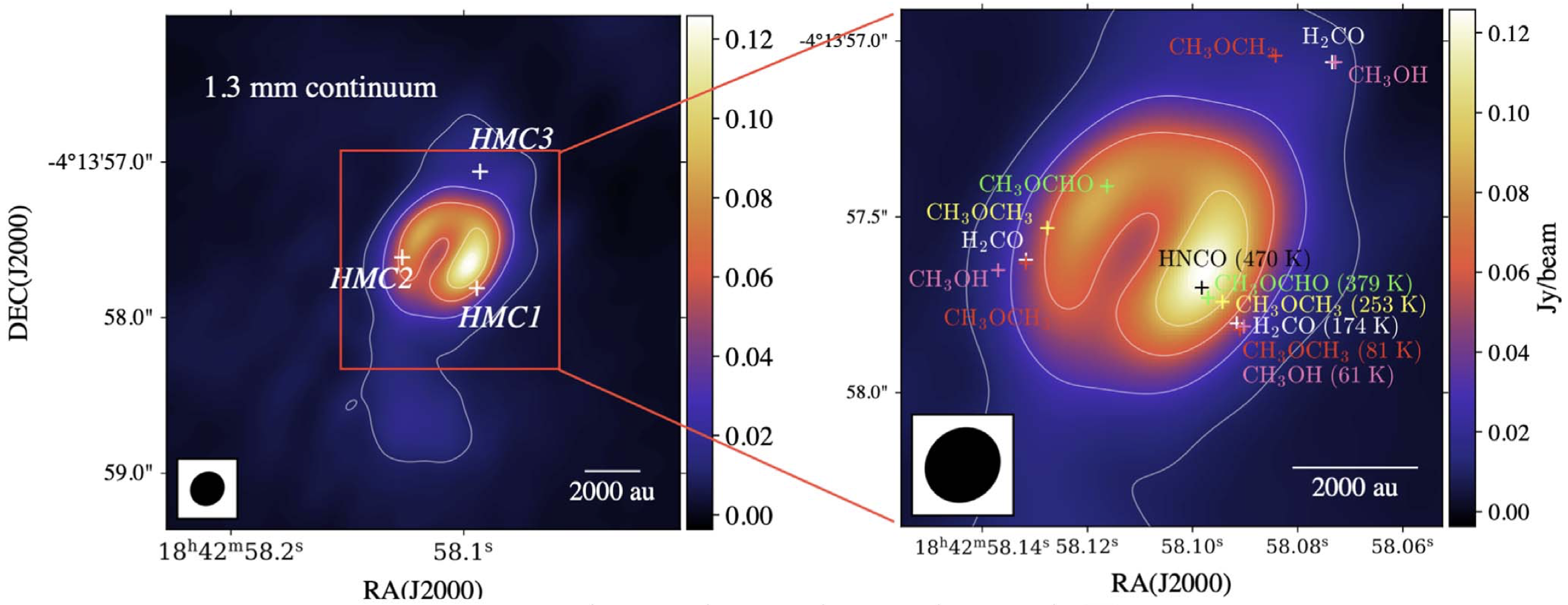
Led by Dr. Prasanta Gorai, a team of astrochemists studied an isolated massive star and uncovered a remarkably rich and complex chemical environment. Using observations from a powerful radio telescope in the Atacama Desert in Chile, researchers uncovered a mix of molecules and used them as “chemical fingerprints” to learn more about how the star is growing.

Predicting the Missing Sulfur Reservoir with Synthetic Observations and Laboratory Experiments
Contributor: Dr. Angèle Taillard
Researchers at the Centro de Astrobiología in Madrid, Spain, led by Asunción Fuente, believe they have identified in which form sulfur is concealed in the galaxy. Just as flour is vital for baking, sulfur plays a key role in building life’s ingredients -- and now, we might finally know where it’s been hiding.

Herschel Space Observatory: A Window into the Chemistry of the Cold, Dark Universe
Contributor: Amanda Alvarado-Torres
Before the James Webb Space Telescope, The Herschel Space Observatory (HSO) was one of the first missions that allowed astrochemists to probe the far-IR field. Operating in wavelengths longer than JWST’s, Herschel was able to pierce into the coldest, darkest parts of the universe.
Unraveling Cosmic Chemistry: New Insights into Formaldehyde Formation
Contributor: Lucille Steffes
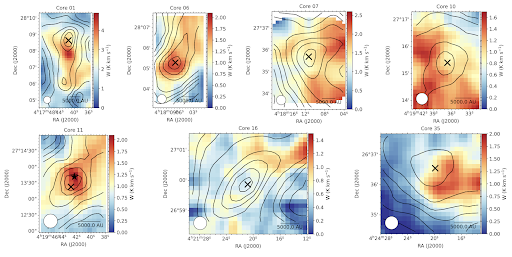
Imagine peering into the cold, dark corners of space, where stars are just beginning to flicker into existence. It is in these cosmic nurseries where key chemical species formaldehyde (H₂CO) and methanol (CH₃OH) are forged. These precursor molecules are vital ingredients for brewing the more complex organic molecules that are essential to understanding how life might have originated on Earth or, perhaps, elsewhere in the universe.

Hidden Nurseries of Stars Unveiled Thanks to a Sweet-Smelling Cosmic Clue
Contributor: Dr. Mélisse Bonfand
Astronomers have uncovered a treasure trove of young stars in the Milky Way galaxy. Revealed not by their light, these stars were discovered due to the telltale glow of a molecule better known on Earth for its sweet, fruity scent: methyl formate.

Unlocking Secrets in Ice with The James Webb Space Telescope
Contributor: Dr. Brielle Shope
When people think of space, they often picture a vast, empty void. But space is far from empty. The interstellar medium (ISM)—the gas and dust that fills the space between stars—is rich with the ingredients for stars, planets, and possibly life itself. These tiny grain particles are like cosmic laboratories, where complex molecules form and evolve. Now, with the James Webb Space Telescope (JWST), scientists can peer into these hidden regions of space to uncover the secrets of ice species, the frozen building blocks of chemistry in space.

Unveiling the Origins of Sulfur in Comets
Contributor: Drew Christianson
A team of astrophysicists led by Duncan V. Mifsud from the University of Kent, UK, has conducted an experimental study to investigate the origin of sulfur-bearing molecules in cometary ices.
Hot off the disk: New detections of complex molecules in warm planet-forming disks
Contributor: Dr. Samanatha Scibelli
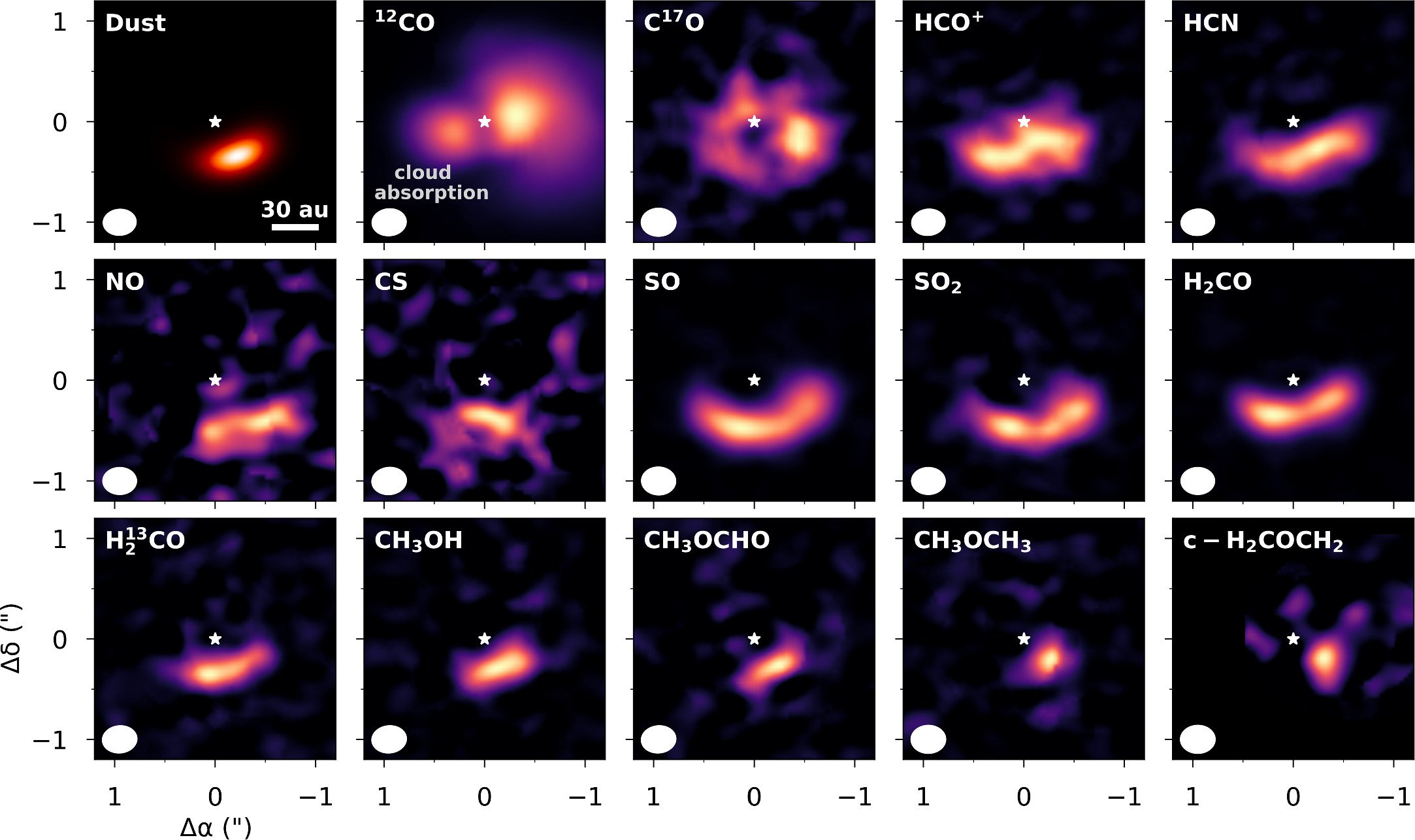
Recent observations of protoplanetary disks—the birthplaces of planets—are challenging our understanding of the chemistry that shapes planetary systems. Using the powerful Atacama Large Millimeter/submillimeter Array (ALMA), researchers detected an unexpected abundance of complex organic molecules (COMs) in two disks, HD 100546 and IRS 48. These molecules, including methanol (CH3OH), methyl formate (CH3OCHO), dimethyl ether (CH3OCH3), and ethylene oxide (c-H2COCH2), are crucial because they are considered precursors to life’s building blocks, such as amino acids and DNA.

Scientists Uncover Flaws in Common Models for Studying Exoplanet Atmospheres
Contributor: Dr. Yassin Jaziri
By using a 3D Global Climate Model (GCM), the team analyzed the atmosphere of GJ 1214 b, an exoplanet located about 48 light-years away. Their work revealed major differences between the results of simple 1D models and the more sophisticated 3D approach. For example, the 3D model identified a clear chemical signature of carbon dioxide (CO2) that the 1D models failed to detect. This was because the 1D models only consider a narrow region around the planet’s edge and cannot account for variations between the hot day side and cooler night side.