Accretion Streamers Feed and Transform Young Protoplanetary Disks
In space, flows of interstellar material (composed of gas and dust particles), known as “streamers,” feed the disks around newly born stars (see Figure 1). These streamers change the chemical and physical properties of the disks, affecting the way in which they form planets. Using radio telescopes, a group of French astronomers has characterized the physical and chemical properties of such a streamer.
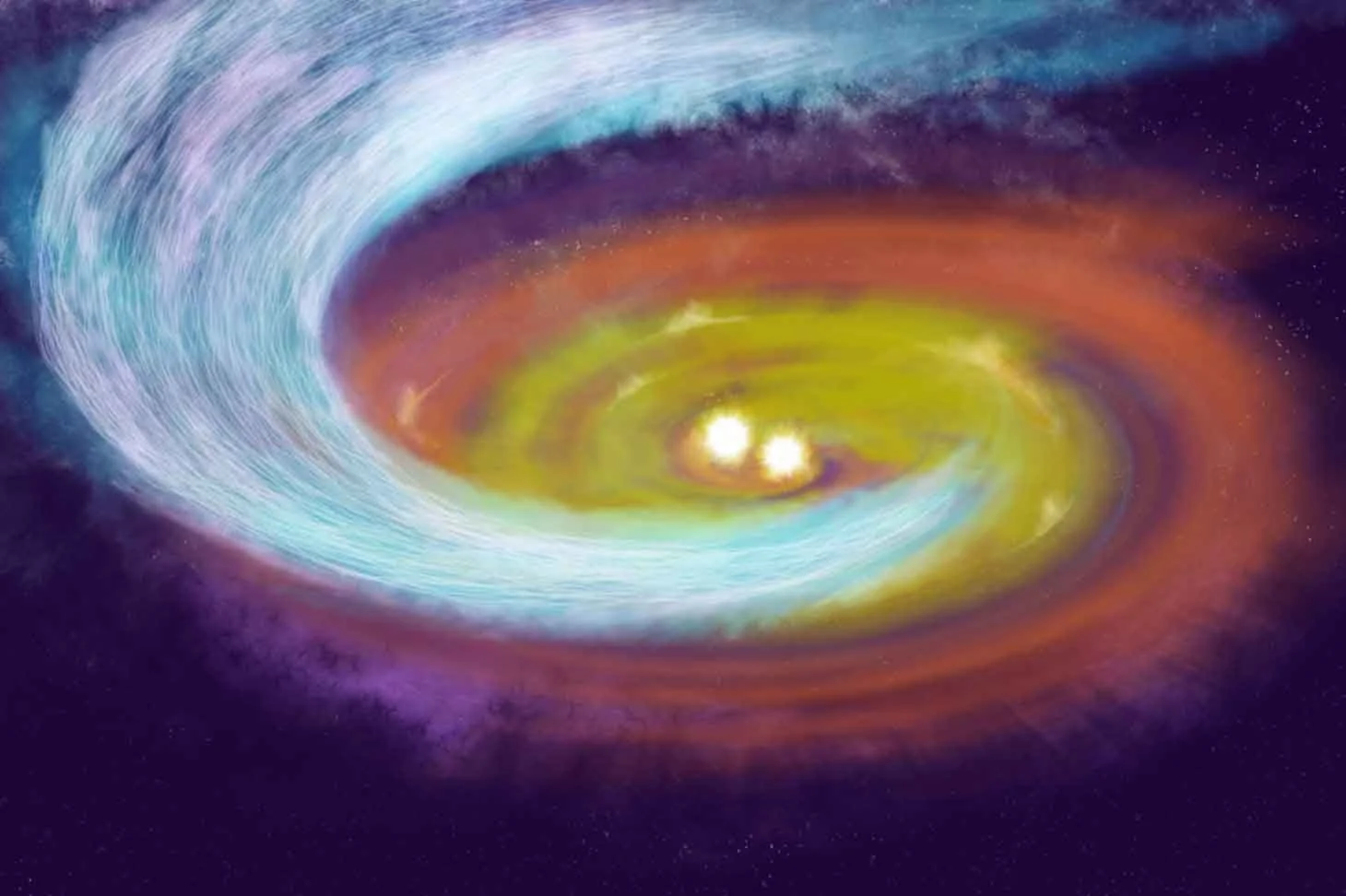
Figure 1: Artist’s impression showing a streamer (in blue) accreting on a protoplanetary disk. Credit: NSF/AUI/NSF NRAO/P.Vosteen.
The processes behind star formation have been the subject of intense research for decades. When new stars (also called "protostars") like our sun are born, they are surrounded by disks made of gas and dust, called “protoplanetary disks”. These disks are the cradle of future planets. In recent years, numerous structures have been observed around these disks, including funneled flows of infalling material called accretion streamers (see Figure 2). They transport material from the protostar’s surrounding environment, called protostellar envelope, to the inner region of the disk. However, the exact role of streamers in the physical and chemical evolution of protostellar disks remains poorly understood.
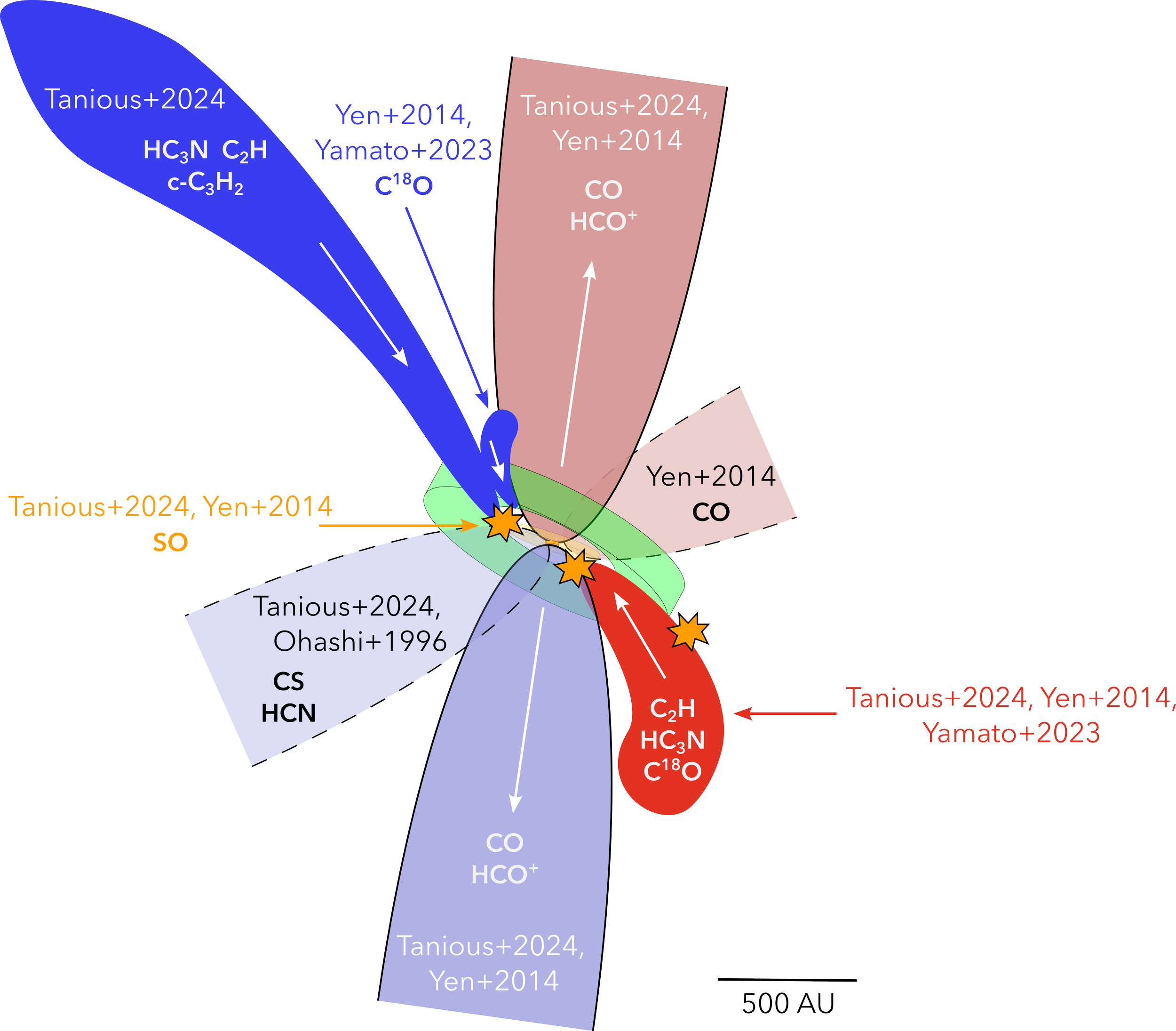
Figure 2: Sketch summarizing the structures detected with molecular emission around the L1489 IRS protostar. The external warped disk is drawn in green, the intermediate disk in yellow, and the inner disk in orange. Blue and red colored structures correspond to the material moving toward (blue-shifted) and away (red-shifted) from the observer. White arrows indicate the direction of moving material (outward for the outflow, inward for the streamers). Accretion shocks are represented with orange stars symbols. A potential second outflow is drawn with dashed contours. Figure adapted from Tanious et al. (2024).
Using the NOEMA radio-interferometer located on the Plateau de Bure in the French Alps, coupled with the IRAM-30m radio telescope in the Spanish Sierra Nevada, a team of astronomers from the Institute of Planetology and Astrophysics of Grenoble (IPAG) and the Institut de Radioastronomie Millimétrique (IRAM) investigated a newly discovered accretion streamer feeding the young protoplanetary disk around the protostar L1489 IRS (see Figure 3).
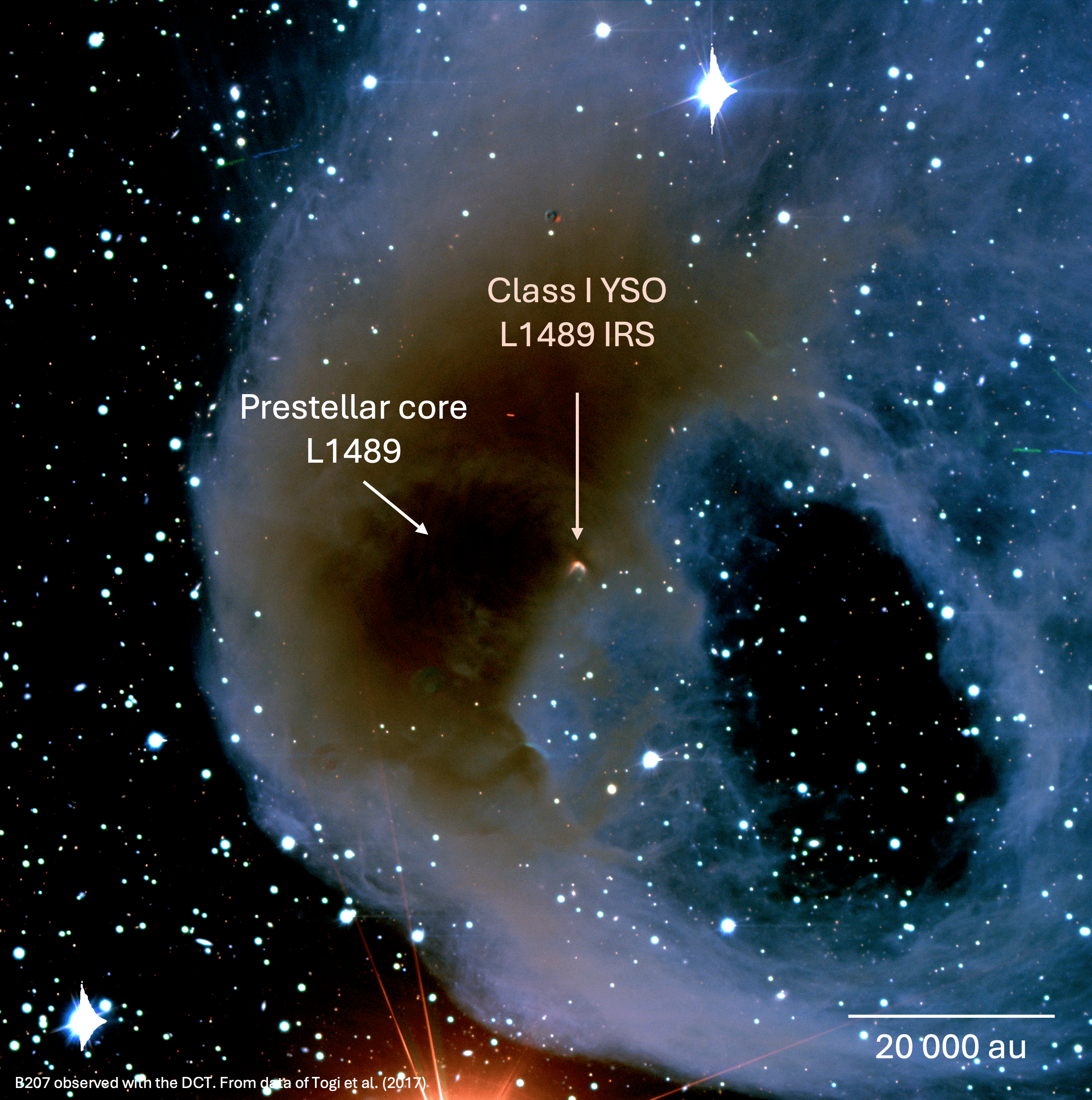
Figure 3. Optical composite image of the molecular cloud Barnard 207 where the Young Stellar Object (YSO) L1489 IRS is born. Image produced from published data of Togi et al., A&A, 605, A99 (2017).
This streamer was identified observing the emission of several molecules, especially small carbon-chain species, such as cyclopropenylidene (c-C3H2), ethynyl radical (C2H), and cyanoacetylene (HC3N), which are precursors of larger organic molecules. These molecules are detected along the funneled elongated structure and can give us information on how the gas is distributed and moving. It connects the protostar to a nearby prestellar core, a gas reservoir that may eventually form a star (see Figure 4).
Computer simulations are used to recreate the shape and motion of the streamer as it falls toward the star. Then the results are compared with the observations to see if the model is accurate. We then used models to reproduce the observed molecules and their emission. These models simulate how light travels through the gas. Because the emission depends on properties like density, temperature, and the number of molecules present, comparing the models with our observations allows us to estimate the physical and chemical properties of the streamer.
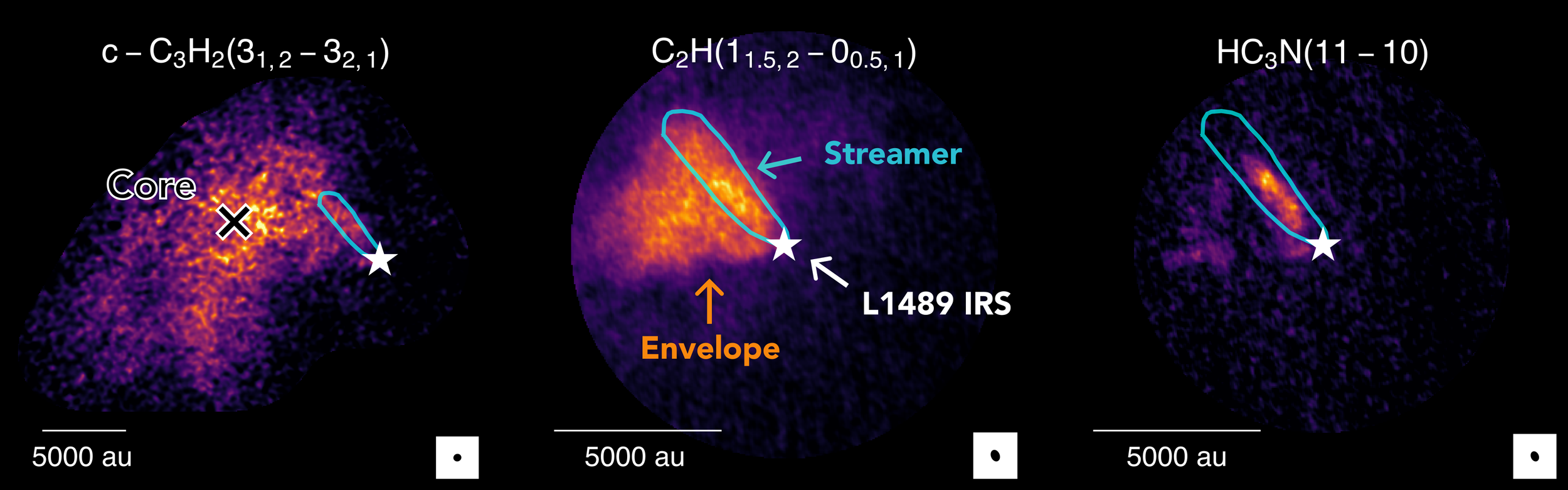
Figure 4. Emission of three carbon-chain molecules observed in the protostellar system L1489 IRS using NOEMA associated with the IRAM-30m telescope. They reveal the accretion streamer (highlighted with the cyan contour) connecting the nearby prestellar core to the protostar.
The results show that the streamer is particularly massive, that it could supply the material that builds the outer disk around L1489 IRS, and that it could have replenished it several times. The streamer also alters the chemical composition of the disk by bringing fresh material from the protostellar natal environment, or material not yet affected by the protostellar activity. This establishes a direct link between the chemistry of the interstellar medium and that of protoplanetary disks, the regions where planets are born.
These results reveal that streamers play a key role in shaping protoplanetary disks by transporting interstellar material into planet-forming regions. They significantly influence the physical and chemical evolution of these systems, prompting a reassessment of traditional star formation models and improving our understanding of the chemical origins of planetary systems.
This article made use of the following publication:
Tanious, M. et al., 2025, Astronomy & Astrophysics, 703, A244. DOI: 10.1051/0004-6361/202555649
Tanious, M. et al., 2024, Astronomy & Astrophysics, 687, A92. DOI: 10.1051/0004-6361/202348785
Original Contributor

Dr. Maxime Tanious
Post-Doc Researcher at ICE-CSIC
Dr. Maxime completed his PhD at IPAG and IRAM and is currently a postdoctoral researcher at ICE-CSIC in Barcelona. His research focuses on understanding the formation and evolution of young stellar objects using (sub-)millimeter facilities such as ALMA, NOEMA, or IRAM-30m.
Editors
Amanda Alvarado
Science Editor
Mélisse Bonfand
Science Editor
Annika Geiger
Senior Editor