A recent study led by T.J. McCoy at the National Museum of Natural History analyzed particles returned from the carbon-rich asteroid Bennu and found evidence of the building blocks of life preserved within them. One of the more important results from this study of the asteroid is the presence of an ancient brine, heavily-salted water that was once trapped within the asteroid parent body. The remnants of these extraterrestrial brines closely resemble the mineralogical environments found in Earth’s closed basins, internal bodies of water which are isolated from external inputs and undergo repeated cycles of evaporation and freezing. Such conditions promote the formation of salts such as sodium bearing carbonates, sulfates, phosphates, chlorides and hydrated minerals, which are known on Earth to host chemical precursors to life.
Brines arise in asteroids from hydrated minerals being captured in fluid during freezing and evaporation. After a fluid evaporates, it leaves behind only trace amounts of salt particles — detectable only via laboratory analysis — on hydrated minerals. These hydrated minerals and particulates can host simple proteins, nucleotides or molecules that support organic structures. These processes and products can aid in the creation of early life, potentially explaining how life on Earth began.
The authors analyzed material collected from the OSIRIS-REx mission Touch-and-Go Sample Acquisition. This mechanism was an arm attached to the OSIRIS-REx spacecraft; it collected over 100 grams of material before returning back to Earth. Scientists then maintained this material within a nitrogen environment to prevent potential chemical changes due to the Earth atmosphere. The scientists analyzed a fingertips worth of sample with a variety of different microscope and laboratory elemental analysis techniques to develop an understanding how these evaporated salts were formed in the asteroid and create a timeline of how these would be formed in an isolated environment. With this information, the timetable from rock and water interactions to life bearing environments to phosphates connecting sugars for DNA-RNA is becoming clearer.
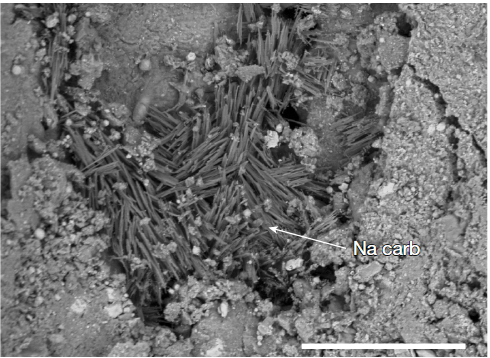
Figure 1: Above is an example of one of the salt molecular structures that is present on the Bennu surface. A scale bar of 20 microns—about the size of a white blood cell—was used for size comparison. Na-Carb or sodium (Na) carbonate is a type of salt that indicates the leadup of a life-hosting environment. A scanning electron microscope was used to create this image. This type of microscope utilizes electrons to raster over a surface and create high resolution images of surface topography, elemental composition, and molecular structures.
This article made use of the following publication:
Original Contributor

Lianis V. Reyes Rosa
University of Virginia
Lianis Reyes Rosa is a 3rd year PhD candidate at the University of Virginia. She works with the Laboratory of Astrophysics and Surface Physics, analyzing carbonaceous asteroids and meteorites with a focus on the effects of space weathering and aqueous alteration.
Editors
Amanda Alvarado
Science Editor
Annika Geiger
Senior Editor
Mélisse Bonfand
Science Editor
Brielle Shope
Editor-in-Chief