A Deep Search for Complex Organic Molecules Around the V883 Ori Protoplanetary Disk
Astrochemist Abubakar M. A. Fadul and colleagues at the Max Planck Institute for Astronomy in Heidelberg, Germany have detected complex organic molecules (COMs) around the young star, V883 Ori, providing strong evidence that rich organic chemistry occurs at early stages of a star’s evolution. The team also reports tentative detections of ethylene glycol and glycolonitrile, molecules regarded as precursors of sugars and nucleic acid building blocks. These molecules are examples of COMs, carbon-containing compounds made of six or more atoms. Together, these results push the frontier of prebiotic chemistry into the disk phase of planet formation. These findings suggest that the basic ingredients for life might begin to form long before planets themselves are fully assembled.
The molecules were detected in a protoplanetary disk (see Fig. 1), the rotating disk of gas and dust that surrounds a young star and eventually gives rise to planets. Early in a star’s life, material collapses from a protostellar core, a dense, cold region of gas and dust where a baby star is just beginning to form. Complex organic chemistry can already occur in these protostellar cores, and some molecules may be carried into the disk as it develops. A subclass of COMs, known as prebiotic molecules, are thought to be involved in the formation of life on Earth. Studying prebiotic COMs in protoplanetary disks can give us insight into how these molecules were delivered to planets like ours.
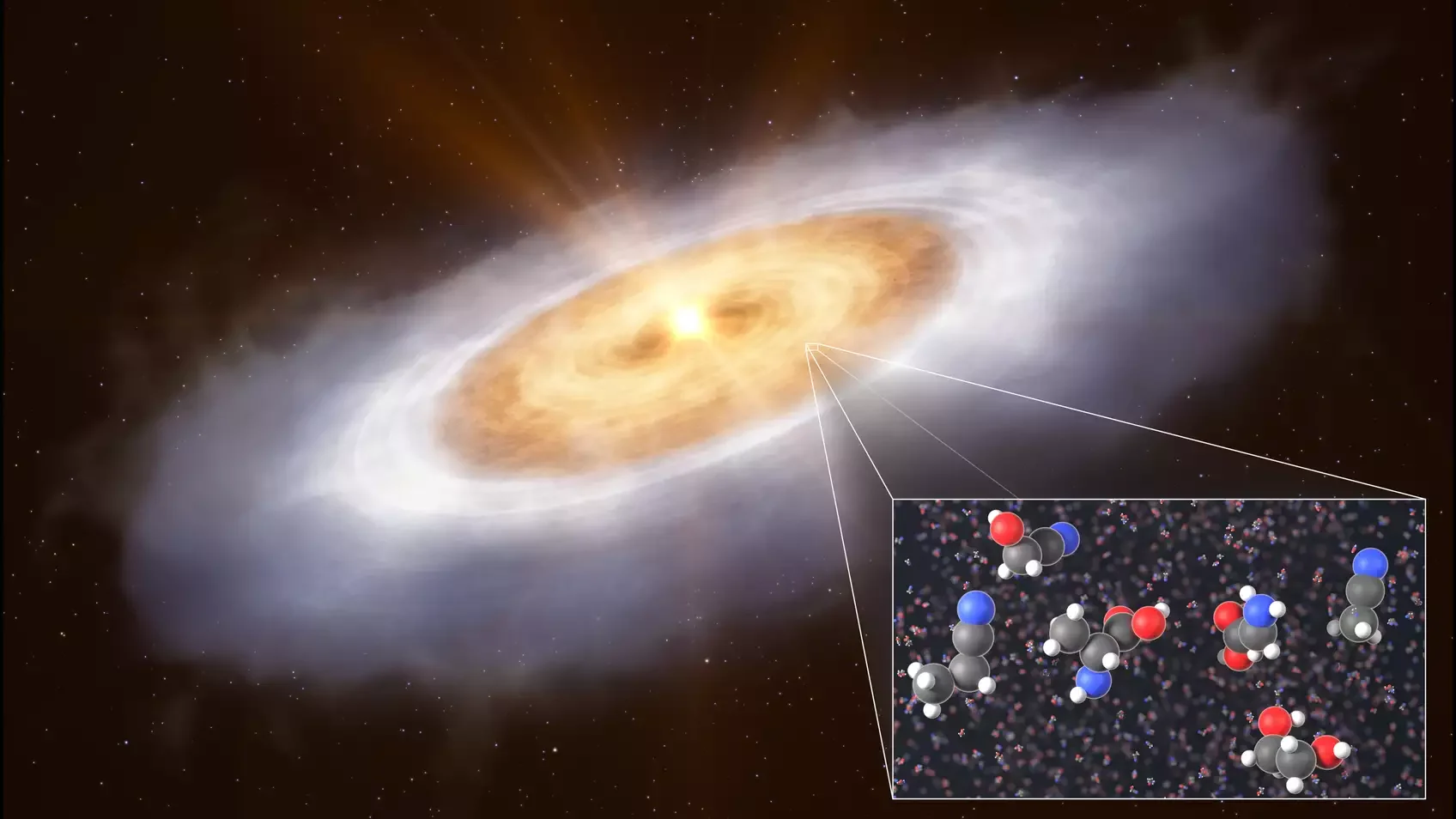
Fig. 1. Artist’s rendition shows the protoplanetary disk of V883 Ori. The inner part shows the region where the molecules are in a gas phase. The outer part shows the region where the molecules are frozen on dust-grain surfaces. HdA).
Credit: ESO/L. Calçada/T. Müller (MPIA/HdA).
As we move farther away from the central star in a protoplanetary disk, the temperature decreases and COMs and simple molecules are frozen on dust-grain surfaces in the outer region (see Fig. 1). Separating the warm inner region from the cold outer region, a snow line marks the location where gaseous species are frozen onto grain surfaces. In the warm inner region of the disk, the molecules are in the gas phase, but the dust is too dense and blocks the signal that is detectable from the molecules.
In unique cases, the central star in some disks, such as V883 Ori, can become brighter and hotter due to infalling material onto the star. Currently, V883 Ori is undergoing a rapid increase in luminosity due to a burst of accretion onto the central star. Consequently, the temperature increases in the outer region, sublimating the ices and liberating the molecules from the grain surfaces, which allows detection of these molecules in the gas phase with the use of a radio telescope such as the Atacama Large Millimeter/submillimeter Array (ALMA).
Fadul and his team identified simple molecules and multiple COMs in the protoplanetary disk of V883 Ori, including the tentative detection of ethylene glycol ((CH₂OH)₂) and glycolonitrile (HOCH₂CN), the prebiotic precursors of sugars and amino acids. Ultimately, Fadul and his team report higher abundances in V883 Ori than in protostellar cores, but lower than in comets. This suggests that protoplanetary disks may play a role in building up COMs.
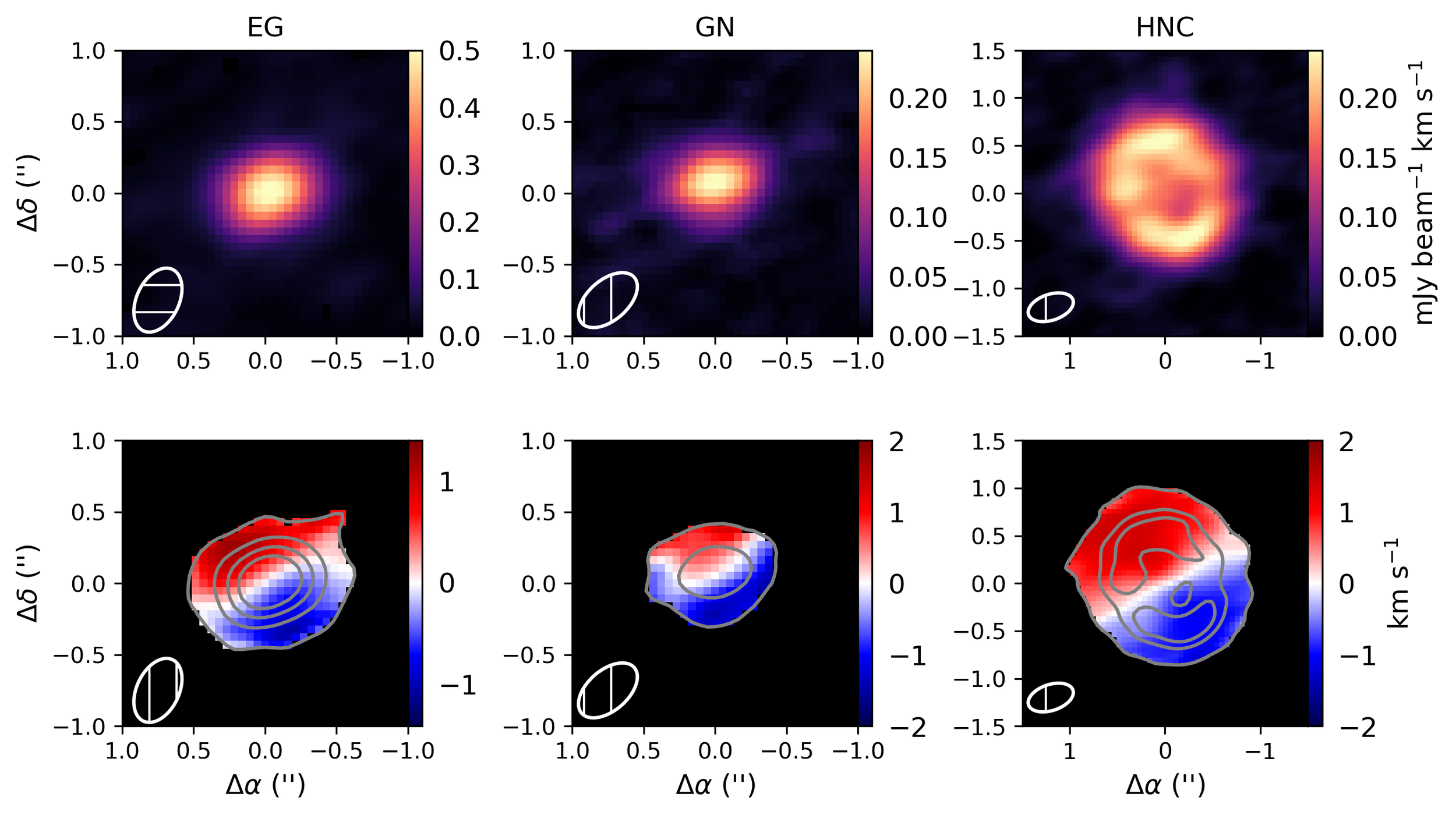
Fig. 2. The top three panels are integrated intensity maps, and the lower three panels are intensity-weighted velocity maps of EG, GN, and HNC, respectively. The moment 1 maps show a clear shift from red-shifted to blue-shifted regions across the disk’s semi-major axis, which matches what we would expect from a rotating disk.
Figure 2 shows the integrated intensity maps (moment 0; the top three panels), which show where each molecule is most strongly detected across the disk. These maps help visualize what the molecular emission looks like and where the molecules are concentrated. The lower three panels show intensity-weighted velocity maps (moment 1), which demonstrate the motion of the molecules across the disk; of EG, GN, and hydrogen isocyanide (HNC). In the moment 1 maps, the blue areas show where the gas is moving toward us, and the red areas show where the gas is moving away from us. These maps inform us about both the distribution and motion of the molecules across the disk.
The results suggest that protoplanetary disks inherit COMs from earlier stages and continue to build more complex molecules at later stages. The team notes that more observations are needed to confirm these detections and to search for even more complex molecules.
This article made use of the following publications:
Original Contributor

Abubakar Fadul
University of Duisburg-Essen
PhD student at the University of Duisburg–Essen, working in astrochemical modelling of star-forming molecular clouds.
Editors
Amanda Alvarado
Science Editor
Annika Geiger
Senior Editor
Brielle Shope
Editor-in-Chief