From Supernova Shocks to Prebiotic Chemistry: How Stellar Death Might Shape the Ingredients of Life
What does it take to form a star? While this question is far from answerable, recent evidence suggests that star formation might involve a blast of waves released by other dying stars, known as “supernova remnants” (SNR).
When massive stars explode as supernovae (or the last stage of a massive star), they send powerful shock waves through the surrounding interstellar medium. These shocks can compress nearby clouds of gas and dust, thus increasing their density and potentially triggering the formation of new stars. SNRs can affect not just the physics but also the chemistry of the compressed gas.
It’s believed that even our own Sun might have formed in this way, and that some of the elements within the human body might have been produced during the interaction of the solar nebula with a nearby SNR. Astronomers routinely detect several molecules toward clouds similar to the solar nebula. The detected molecules range from very simple, like carbon monoxide (CO), to complex organic molecules (COMs), that contain more than six atoms and are considered stepping stones toward prebiotic chemistry. Studying the chemical composition of regions impacted by supernova shocks can therefore help us understand how the ingredients for life might have been assembled.
In a recent study, scientists analyzed the chemical composition of the star formation triggered by the SNR W44 toward the dense cloud G034.77-00.55. This region is located at ~10.000 light years away from us and appears in the direction of the Aquila constellation. To understand what happens there, scientists conducted a sensitive chemical survey using radio observations from the IRAM 30m and Yebes 40m telescopes.
By analyzing the emitted radiation, we can identify the molecules present in the gas and estimate their abundances, effectively taking a chemical snapshot of a region on the verge of forming stars. Results showed that the gas affected by the supernova shock contains both deuterated molecules—species enriched in heavy hydrogen—and complex organic molecules (COMs), such as methanol (CH3OH), acetaldehyde (CH3CHO), and methyl mercaptan (CH3SH). These molecules provide important clues about the physical conditions of the gas. Deuterated species form efficiently in cold, early-stage environments, and their abundance in the gas affected by the supernova shock is much higher than the cosmic average, indicating temperatures of only a few tens of degrees above absolute zero.
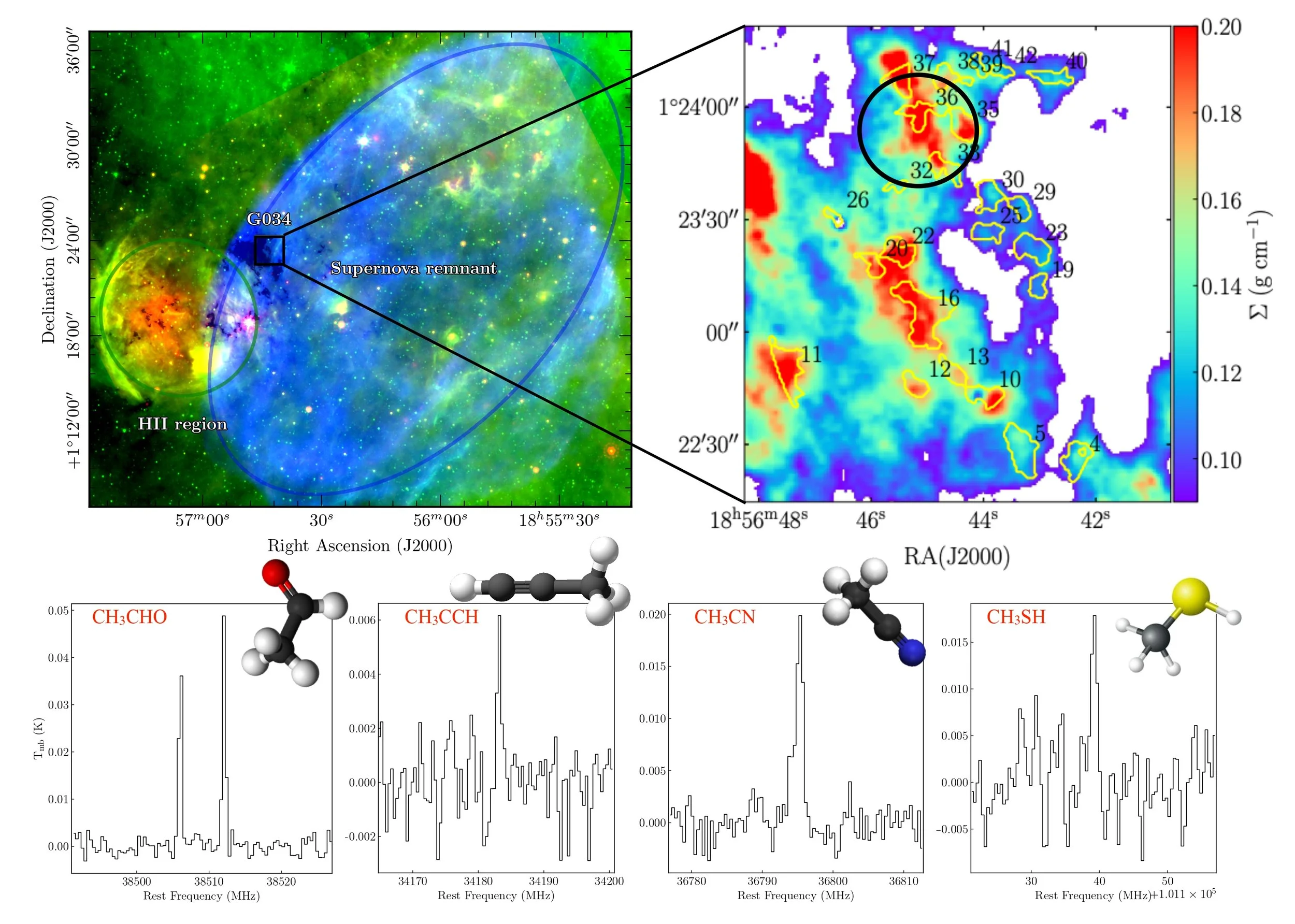
Figure 1: Top Left: Three color image of the molecular cloud G34.77-00.55 and the SNR W44. Red is infrared emission at 24 µm from the MIPSGAL survey (Carey et al. 2009), green is 8 µm infrared emission from the GLIMPSE survey (Churchwell et al. 2009) and blue is 1 GHz radio emission from the THOR survey (Beuther et al. 2016). Top Right: Mass surface density map (Kainulainen & Tan 2013) with indicated the location of the triggered star formation (yellow; Cosentino et al. 2025a). Bottom: Spectra of COMs identified toward a region of triggered star formation (Cosentino et al. 2026.)
Simultaneously, the presence of COMs shows that chemical complexity is already emerging, even before a star has formed. Crucially, there is no evidence of embedded protostars in this region; i.e., no infrared sources and no compact dust emission. This suggests that we can observe the initial conditions of star formation as they are being set.
When we compare the chemistry of the cloud impacted by W44 with other environments, we see that it closely resembles that of regions where Sun-like stars are born. Even more intriguingly, the relative abundances of complex molecules are similar to those found in comets in our own solar system. This raises an exciting possibility: that the chemical ingredients that seed planetary systems, and perhaps life as we know it, might be established very early on, in environments shaped by shocks. In other words, the explosive death of one star could help determine the chemical makeup of the next generation of stars and planets.
The article made use of the following publications:
Beuther et al. 2016, A&A, 595, A32
Carey et al. 2009, , PASP, 121, 76
Churchwell et al. 2009, , PASP, 121, 213
Cosentino et al. 2025a, A&A, 693, A199
Cosentino et al. 2026, A&A, 707, A95
Kainulainen & Tan 2013, A&A, 549, A53
Original Contributor

Dr. Giuliana Cosentino
G. Cosentino is an astronomer at the European ALMA Regional Centre and the NOEMA Science Operations Group, at IRAM in Grenoble. She seeks to understand how large-scale shocks in the interstellar medium might shape star formation in the Milky Way, in addition to supporting the scientific community in the use of the NOEMA and ALMA interferometers.
Editors
Amanda Alvarado
Science Editor
Brielle Shope
Editor-in-chief
Annika Geiger
Senior Editor