

Unveiling the Origins of Sulfur in Comets
Contributor: Drew Christianson
A team of astrophysicists led by Duncan V. Mifsud from the University of Kent, UK, has conducted an experimental study to investigate the origin of sulfur-bearing molecules in cometary ices.
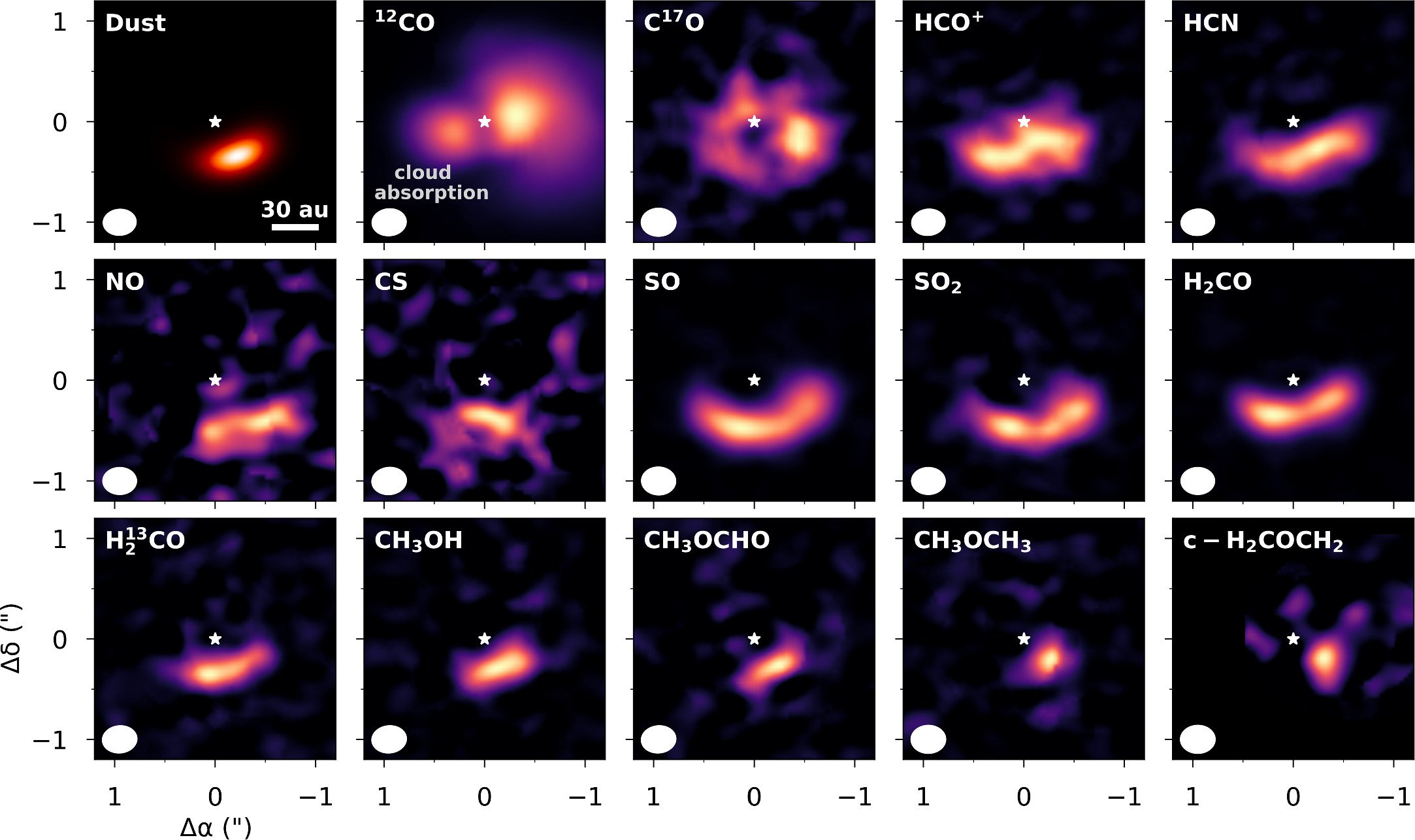
Hot off the disk: New detections of complex molecules in warm planet-forming disks
Contributor: Dr. Samanatha Scibelli
Recent observations of protoplanetary disks—the birthplaces of planets—are challenging our understanding of the chemistry that shapes planetary systems. Using the powerful Atacama Large Millimeter/submillimeter Array (ALMA), researchers detected an unexpected abundance of complex organic molecules (COMs) in two disks, HD 100546 and IRS 48. These molecules, including methanol (CH3OH), methyl formate (CH3OCHO), dimethyl ether (CH3OCH3), and ethylene oxide (c-H2COCH2), are crucial because they are considered precursors to life’s building blocks, such as amino acids and DNA.

Scientists Uncover Flaws in Common Models for Studying Exoplanet Atmospheres
Contributor: Dr. Yassin Jaziri
By using a 3D Global Climate Model (GCM), the team analyzed the atmosphere of GJ 1214 b, an exoplanet located about 48 light-years away. Their work revealed major differences between the results of simple 1D models and the more sophisticated 3D approach. For example, the 3D model identified a clear chemical signature of carbon dioxide (CO2) that the 1D models failed to detect. This was because the 1D models only consider a narrow region around the planet’s edge and cannot account for variations between the hot day side and cooler night side.

Life’s Building Blocks Have a Handedness and a Cosmic Connection
Contributor: Kamil Stelmach
Despite the seemingly chaotic and unhospitable environment represented by space, life’s most fundamental building blocks can still emerge. Through spacecraft missions and sample returns, amino acids and sugars have been found in carbonaceous meteorites. On Earth, these molecules show a preference for a particular handedness - which are versions of a molecule that are mirror images of each other (see Figure 1). Whereas most abiotic reactions give an even split between left- and right-handed molecules, the compounds in carbonaceous meteorites are biased toward a particular handedness. But not just any particular handedness. As noted by Glavin et al. (2019), amino acids are biased toward left-handed variants and sugar alcohols are biased toward the right-handed versions, which are the same set of handedness as used by life!

Galactic sandbox: From quartz clouds to lunar water generation
Contributor: Athena Flint
The simplest chemical pathway leading to formation of both circumstellar dust grains and ultimately the lunar crust begins with reactions of silicon monoxide (SiO) with water at temperatures of 1643 K (1916 °C, 2498 °F) and above in an article published in the October 11, 2023 issue of the journal ACS Earth and Space Chemistry by Flint and Fortenberry. Continued addition of SiO and H2O molecules is predicted to result in growth of the silica (SiO2) mineral precursor. Quantum chemical generation of this reaction pathway produces precursors as large as the silicon dioxide trimer, which can be extrapolated to the silicon dioxide hexamer, a stand-in for larger silica grains.

Detections of Complex Molecules in Interstellar Ices
Contributor: Dr. Brielle Shope
The James Webb Space Telescope (JWST) illustrates its potential through three new detections of biological precursors in interstellar ices. Will Rocha and team, part of the JWST Observations of Young protoStars (JOYS+) project, detected a total of ten molecules in their ice form around forming stars. Previously inaccessible to humankind, the recently launched JWST provides astronomers access to infrared radiation at the highest levels of sensitivity and resolution. By looking at infrared radiation, astronomers can detect ices in space. The surfaces of these ices are where scientists believe to be the birthplace of complex molecules in space. The detections of these complex molecules on ices is further evidence of their formation on ice surfaces rather than solely in the gas-phase.

The environment of massive stars is salty!
Contributor: Dr. Mélisse Bonfand
In 2019, a team of astronomers led by Drs. Adam Ginsburg and Brett McGuire detected the chemical fingerprints of table salt - Sodium Chloride (NaCl) - and other similar salty compounds, about 1500 light-years from Earth, in the dusty disk surrounding a young star in the Orion Nebula. Since then, eight more salty disks have been detected, suggesting that salt emission is not rare in star-forming environments.